
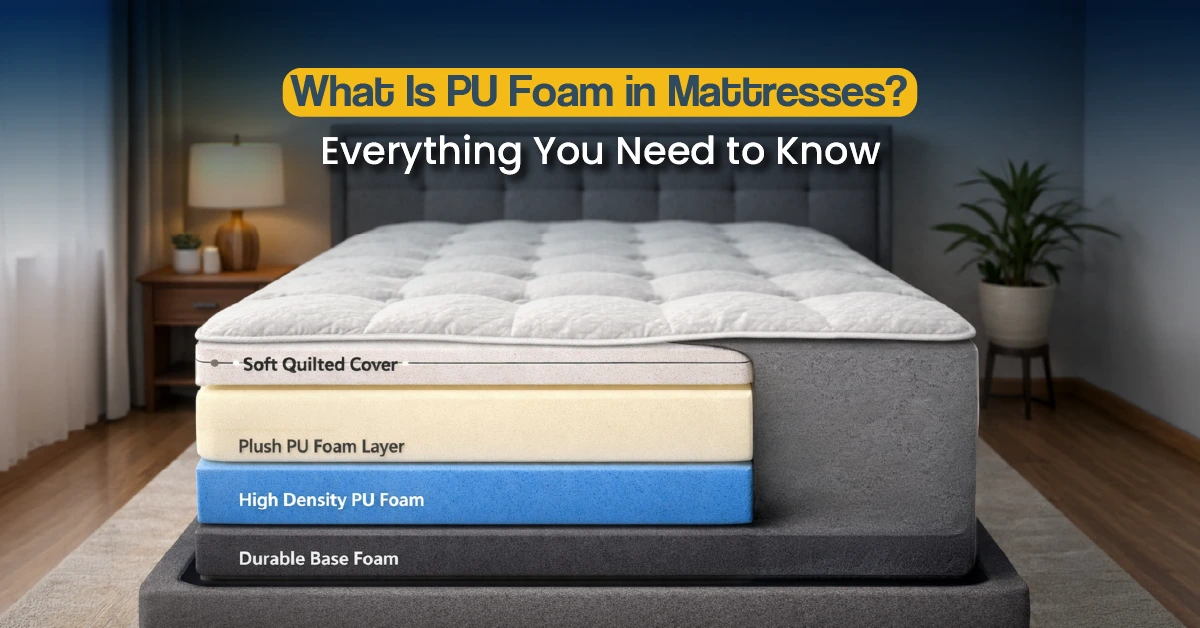

PU foam is one of the most common cushioning materials inside mattresses sold in India. Yet “PU foam” can mean very different things depending on the grade, density, and how the layers are built. In this blog, you will learn the PU foam full form, the polyurethane foam meaning, what PU foam density really tells you, and the everyday PU foam uses. You will also see when PU foam is a smart choice for sleep and how to judge quality before you buy.
PU Foam Full Form: What Does PU Stand For?
The PU foam full form is polyurethane foam. “PU” is short for polyurethane, a polymer that can be engineered into foams with different feels and performance levels.
What is PU Foam?
PU foam is polyurethane expanded into a cellular structure. The polyurethane foam meaning includes:
- Flexible, open-cell foam that cushions and rebounds
- Firmer, tighter-cell foam used when more structure is needed
In mattresses, you will mostly find flexible PU foam as the core, the comfort layer, or both.
How is Polyurethane Foam Made?
Manufacturers mix two liquid components, polyol and isocyanate, and the reaction creates a rising foam. Additives control how fast it rises, how big the cells are, and how soft or firm it becomes. After curing, the foam is cut into sheets and layered into a mattress, often with quilting and a fabric cover.
Types of PU Foam
PU foams are grouped by how they behave. Knowing the type helps you predict bounce, firmness range, and typical use.
Flexible Polyurethane Foam (FPF)
FPF is the standard mattress PU foam. It can be soft, medium, or firm, and is used as a main support core or as a comfort layer in hybrid builds.
Rigid Polyurethane Foam (RPF)
RPF is hard and usually closed-cell. It is popular for insulation and panels, so it is not a typical mattress comfort material.
Spray Polyurethane Foam (SPF)
SPF expands when sprayed and is used for sealing and insulation in buildings. It is not commonly used in mattresses because mattresses need uniform sheets and controlled thickness.
Reticulated Polyurethane Filter Foam
Reticulated foam is very open and breathable. It is mainly used in filtration and niche breathable cushioning, rather than in standard mattress cores.
Speciality and Modified Grades
Foam can be tuned for specific outcomes, such as higher resilience (more bounce), softer quilting foams, or improved airflow through cell design.
Also Read: Memory Foam vs PU Foam Mattress: Which One is Right for You?
PU Foam Density: What It Means & Why It Matters
PU foam density is the foam’s mass per cubic metre (kg/cubic meter). It is not the same as firmness, but it strongly influences how well the foam holds up.
Density matters because it affects:
- How quickly the core softens with use
- How well support stays even across the surface
- The overall “substantial” feel of the mattress over time
When brands share only “soft” or “firm”, ask for the support-layer density to compare models fairly.
Uses of PU Foam
Because it is versatile, PU foam uses go beyond bedding. Common applications include:
- Mattresses, pillows, and sofa seats
- Automotive seating
- Protective packaging
- Sound and thermal insulation products
Is PU Foam Good for a Mattress? Pros & Cons
PU foam can be excellent in the right build, especially when the core density matches the expected usage.
Pros
- Good value compared to many latex options
- Easy to move on, with a quick response
- Works well in hybrids for balanced comfort
Cons
- Low-density cores can sag sooner
- Some designs can feel warm in humid weather
- Mild new-foam odour may need airing
How to Check PU Foam Quality Before Buying
A few checks help you avoid vague claims and choose a mattress that stays supportive.
Do this:
- Ask for the support-core density (kg/cubic meter) and layer thickness
- Check warranty terms and what sag depth is covered
- Lie down for 10 minutes in your usual sleep position
- Notice pressure build-up at shoulders and hips, and any mid-back gap
Also Read: Best Pillow for Sleeping – Comfort, Support & Better Sleep
PU Foam Mattresses by Centuary India: What to Expect
If you want a PU foam mattress that feels familiar, sleeps comfortably in Indian weather, and still gives you clear choices across budgets, Centuary India is a strong place to start. Instead of buying only by “soft” or “hard”, you can narrow it down by build, feel, and core specifications that actually determine long-term comfort.
Here is what you will typically find when you explore Centuary India’s PU foam range:
- Different firmness options for different sleepers
- Full-foam and hybrid constructions
- Quilted top panels that change surface softness
Compare core density, total thickness, and comfort feel before deciding. Choose the one that keeps your spine neutral without creating pressure hotspots.
Conclusion
PU foam is a broad material family, so quality depends on grade, density, and construction. If you understand the polyurethane foam meaning and check PU foam density before buying, you can confidently choose a PU foam mattress that feels comfortable now and stays supportive later, for your budget and sleep style, too.
FAQs
What is the full form of PU foam in mattresses?
The PU foam full form is polyurethane foam, most often flexible polyurethane foam used in mattress comfort layers and support cores.
Is PU foam better than memory foam?
PU foam is usually more responsive, while memory foam contours more deeply. Many sleepers prefer a hybrid that combines both feels.
What density of PU foam is best for mattresses?
There is no single best number, but avoid low-density support cores for long-term use. Ask for the exact PU foam density (kg/m³) and compare models based on your body weight and firmness needs.
How long does a PU foam mattress last?
Higher-density cores generally last longer than low-density foams. Use, body weight, and rotation also affect lifespan.
Does PU foam retain heat?
It can feel warm if airflow is limited. Breathable covers and better ventilation in the build help.
Can PU foam mattress cause back pain?
Back pain is more likely if the mattress is too soft, too firm, or sagging. Choose a firmness and build that keeps your spine neutral.
