
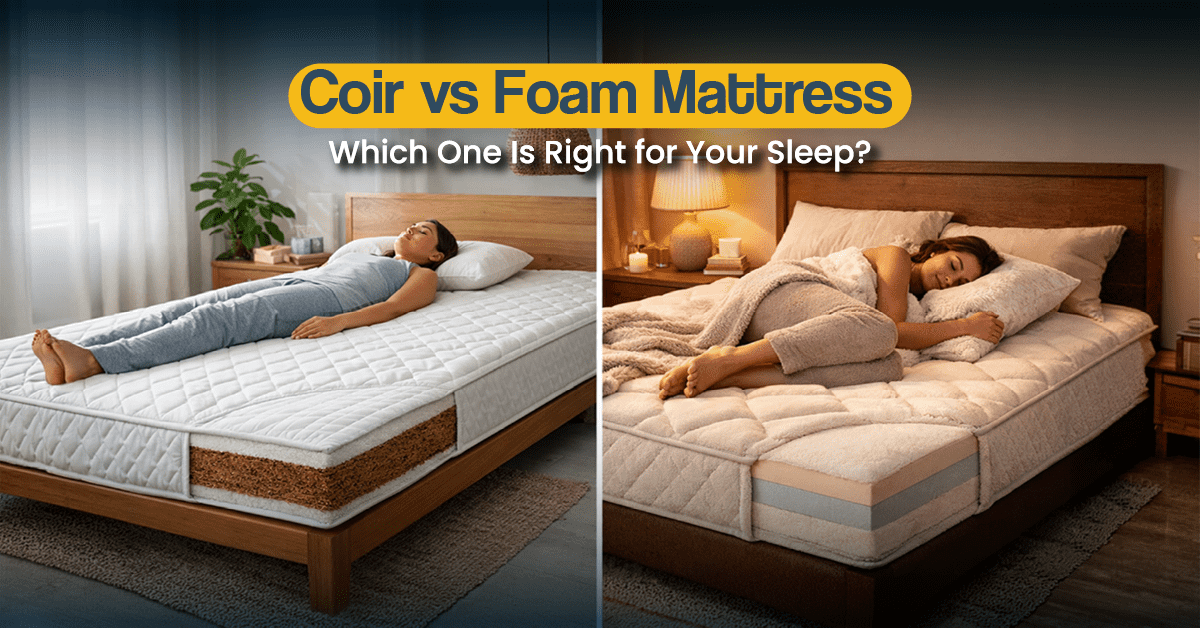

Your mattress should keep your spine aligned and help your body relax. When you compare a coir vs foam mattress, focus on support feel, pressure relief, heat, and how the mattress holds up in Indian weather.
What Is a Coir Mattress?
A coir mattress uses coconut fibre sheets as a firm core, often with a thin comfort layer on top. It feels flat and supportive.
What you can expect:
- Firm surface with little sink
- Airy feel that many people like in summer
- Works best on a strong, even bed base
Some coir models add a thin quilted top.
What Is a Foam Mattress?
A foam mattress is built with layers such as PU foam, HR foam, or memory foam. The feel depends on density and layering.
Typical benefits:
- Better cushioning for shoulders and hips
- Choices from medium-soft to firm
- Less partner disturbance because foam absorbs movement
If you can, ask for foam density or grade, because higher density usually means steadier support and slower softening.
Also Read:- Coir Mattresses: Natural, Affordable, and Comfortable – Centuary Mattress
Difference Between Foam and Coir Mattress in Terms of Comfort and Support
Both can suit you, but they respond differently under body weight. Here is the difference between foam and coir mattress in a quick view.
|
Feature |
Coir mattress |
Foam mattress |
|
Feel |
Firm, flat |
Adaptive, can be plush to firm |
|
Support style |
Surface support |
Contouring support |
|
Pressure relief |
Moderate |
Usually higher |
|
Motion transfer |
Medium |
Low |
|
Cooling |
Naturally airy |
Depends on foam and cover |
|
Best fit |
Firm-sleep lovers |
Side and mixed sleepers |
Also, check the mattress thickness: very thin models can feel harsh, while thicker models usually spread weight more evenly overnight.
Coir Mattress vs Foam Mattress: Which Is Better for Back and Spine Health?
Back comfort is about neutral alignment, not maximum hardness. If the hips dip, the lower back strains. If the surface is too hard, pressure points build.
Coir can suit you if you sleep mostly on your back and prefer a firm feel. Foam can suit you if you need your waist supported while your shoulders and hips settle in evenly. When you compare a coir mattress vs foam mattress, choose the option that feels supportive without morning stiffness.
Coir or Foam Mattress: Which Is Better for Different Sleep Positions?
If you are asking coir or foam mattress which is better, start with your main sleep position.
Your sleep position changes what “comfortable” means.
- Back sleepers: firm coir or firm foam with steady lumbar support
- Side sleepers: medium to medium-firm foam often feels gentler
- Stomach sleepers: firmer is safer, avoid soft foam that lets hips sink
Heat Control and Airflow: Which Mattress Sleeps Cooler?
Coir usually sleeps cooler because air moves through the fibre. Foam can feel warmer, especially thick memory foam, but breathable covers and ventilated layers can help.
For better cooling:
- Use cotton bedsheets and a breathable protector
- Avoid thick toppers unless you truly need them
Also Read: Hybrid vs. Memory Foam Mattresses: Which One Suits Your Sleep Style?
Durability and Lifespan Comparison
Quality matters more than material alone. Coir can sag faster if it faces dampness or poor support. Foam can form impressions early if the density is low.
Rotating the mattress every three to six months helps wear stay even, especially on single-sided foam designs used in many homes.
Before you buy, check firmness consistency, thickness, warranty, and brand support. For long-term value, mattress foam vs coir is a build-quality decision first.
Who Should Choose a Coir Mattress or Foam Matters?
Match your pick to comfort preference, body needs, and climate.
Choose coir if you:
- Want a firm, flat surface with minimal sink
- Sleep hot and prefer an airy feel
- Want a simpler, budget-friendly option
Choose foam if you:
- Need pressure relief for shoulders, hips, or knees
- Share a bed and want less movement transfer
- Want more choice in feel and support
If you are unsure, take a short home trial or do an in-store test for 10 to 15 minutes in your usual sleep position.
Conclusion – Coir or Foam Mattress – Which Is Better for You?
Coir fits you if you like firmness and a cooler, flatter feel. Foam fits you if you want cushioning and a surface that adapts to your body. The best test is simple: lie down in your usual sleep position with your usual pillow and check whether your hips, waist, and shoulders feel supported and relaxed.
Frequently Asked Questions (FAQs)
Back support comes from alignment. Coir can work if it supports your lower back without feeling painfully hard. Foam can work if it supports your waist while reducing pressure on your shoulders and hips.
Both can last well with good quality. Keep coir away from moisture and choose a suitable foam density to avoid early softening. Use the warranty as a quality signal.
Coir needs a dry room and a solid base. Foam is simple for daily use but can be heavier to move. A protector and regular airing help both.
Low-density foam can lose shape sooner, while good foam holds up better. Coir can also sag if the quality is poor or if it is exposed to moisture. Check specs and warranty, not just the label.
