

Summary
- A mattress cannot cure sciatica, but the right one can reduce strain, improve alignment, and make sleep more comfortable.
- Medium-firm support with pressure relief usually works best, especially when it prevents the hips from sinking too deeply.
- Latex, memory foam, hybrid, and dual-comfort mattresses can all help if they match your sleep position and body weight.
- Avoid miracle claims and choose support, breathability, and durability instead.
Sciatica can turn bedtime into a negotiation. You lie down, shift once, and pain travels from the lower back into the hip or leg. A good mattress for sciatica cannot fix an irritated nerve, and cure claims are overpromises. But it can keep your body steady, reduce pressure, and limit stiffness, aiding in overall recovery.
What Is Sciatica and Why Does It Affect Sleep?
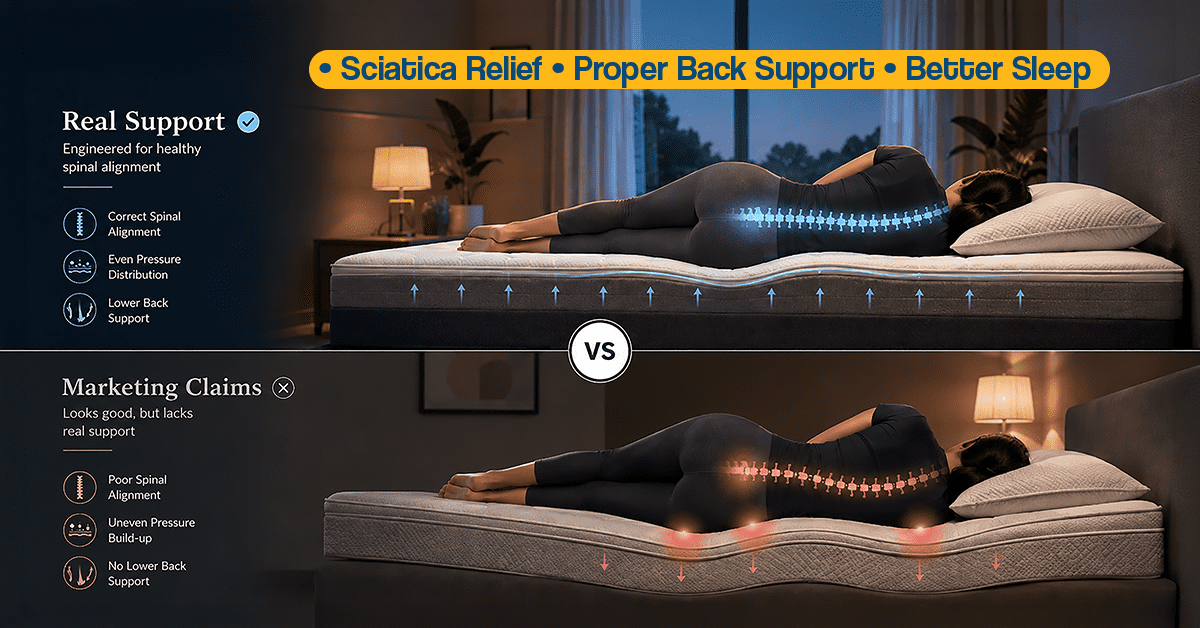
Sciatica is usually felt as pain, tingling, numbness, or weakness running from the lower back down one leg. It often feels worse at night because the body stays in one position for hours. If the mattress sags, the pelvis may dip and twist the lower back. If it is too hard, the hips and shoulders may take too much pressure. Either way, sleep breaks, and the morning starts tight.
Can the Right Mattress Help Relieve Sciatica Pain?
The right mattress for sciatica pain can support your lower back, but it should be seen as part of care, not the whole solution. Most people need sensible movement, posture awareness, guided stretching, and medical advice when pain is severe or persistent.
What actually helps is alignment. Your spine should look relaxed, not bent sharply at the waist. Your hips should feel supported, not swallowed. Your shoulders need enough cushioning. Ignore claims like “instant nerve relief” or “permanent pain removal”. A mattress can make sleep comfortable; it cannot diagnose or treat the cause.
Also Read:- Which Type of Mattress is Best for Back Pain in India
What Type of Mattress Is Best for Sciatica?
People often ask what type of mattress for sciatica is right. The honest answer is: choose by support, pressure relief, and sleep style.
Centuary options can fit different needs:
- Latex support: The Centuary Sleepables Natural Latex Mattress uses breathable natural latex, ergo-soft foam, Xbounce Hi-Rez Foam with Anti Sag technology, and a 3D Air Mesh border. It may suit sleepers who want bounce and airflow.
- Reversible comfort: The Centuary Dual Comfort Foam Mattress offers two comfort levels. During a flare-up, some people prefer a firmer side; on calmer days, a softer feel may be enough.
- Semi-firm contouring: The Centuary Sleepables Ortho Memory Mattress has contour foam, Intelligent Airflow technology, and anti-microbial Centuary Protect treatment. It suits people who like moulding with back support.
- Hybrid feel: The Centuary Sleepables Hybrid Pocket Spring Mattress combines pocketed springs with Copper Gel Memory Foam and a removable zip cover. It can work for those who want lift, airflow, and cushioning.
Mattress Comparison for Sciatica
| Mattress type | What may help | Possible concern |
|---|---|---|
| Latex | Responsive support and breathability | May feel springy at first |
| Memory foam | Pressure relief and contouring | Too-soft foam can trap hips |
| Ortho foam | Firmer back support | Can feel rigid if over-firm |
| Hybrid pocket spring | Support with airflow | Poor layers may sag |
| Dual comfort | Choice of firmness | Both sides must align the spine |
This is why the best mattress for sciatica is not always the costliest one. It is the mattress that keeps your lower back calm and your body balanced.
Best Mattress Based on Your Sleeping Position
Side sleepers need cushioning at the shoulder and hip, plus firmness to stop the waist from collapsing. A pillow between the knees can keep the pelvis level.
Back sleepers do well with a medium-firm feel. A small pillow under the knees can reduce lower-back strain.
Stomach sleepers may struggle because this position can arch the back and rotate the neck. If you cannot change the habit, choose firmer support and a thin pillow.
Combination sleepers should look for quick response, so turning does not feel like climbing out of a hollow.
Mattress Features That Actually Help Sciatica
Look for practical features, not dramatic words:
- Medium-firm support that prevents dipping.
- Pressure relief around the hips, shoulders, and lower back.
- Breathable construction for warm Indian weather.
- Strong edges for easier sitting and getting up.
- Motion control if a partner moves often.
- Materials that recover shape instead of forming body dents.
Also, check the base. A solid mattress on uneven slats or a weak cot can lose support quickly. Many Indian homes keep mattresses for years longer than they should, so sagging, lumps, or a permanent dip are warning signs.
Also Read:- How Sleeping Positions Affects Our Back
Tips for Sleeping Comfortably with Sciatica
Before buying anything, improve your sleep setup. Sleep on the side that hurts less, bend the knees slightly, and place a pillow between them. If lying on your back feels better, keep a pillow under your knees. Avoid sitting in bed with your lower back rounded. Scrolling in a twisted posture can undo a good mattress.
In the morning, get up slowly. Roll to one side, use your hands, and stand. If pain comes with leg weakness, numbness in the groin area, or bladder or bowel trouble, seek medical help urgently.
Choosing the Right Centuary Mattress for Sciatica Support
A Centuary mattress should be chosen by feel, not just by the word “ortho”. Choose Natural Latex if you want breathable bounce and do not like sinking. Consider Dual Comfort Foam if your firmness preference changes. Look at Ortho Memory if you want a semi-firm contouring surface for back support. Try Hybrid Pocket Spring if you prefer a lifted feel with cushioning.
Vacuum-packed options are practical in apartments, especially where staircases or lifts are narrow. Once opened, allow the mattress to expand fully before judging comfort.
Conclusion
So, what is the best type of mattress for sciatica? It is a medium-firm, pressure-relieving, non-sagging mattress that matches your body and sleeping position. Do not buy fear or miracle promises. Buy support, comfort, breathability, and durability. If pain continues, let a doctor or physiotherapist guide the bigger plan.
FAQs
Can a mattress cure sciatica permanently?
No. It can improve sleep posture and comfort, not cure sciatica.
Is memory foam always the best mattress for sciatica?
No. Some prefer memory foam; others do better on latex, hybrid, or dual comfort.
How often should I replace my mattress if I have sciatica?
Replace it when it sags, loses support, or causes morning stiffness.
Can an old mattress trigger sciatica flare-ups?
It may not cause sciatica, but poor support can worsen discomfort.
Should side sleepers with sciatica choose a softer mattress?
Not always. They need cushioning without hip sink.
Can a mattress topper help with sciatica pain?
A topper can soften firmness, but not fix sagging.
Are orthopaedic mattresses suitable for all people with sciatica?
No. The mattress must suit your weight, posture, and comfort preference.
Does body weight affect the best mattress choice for sciatica?
Yes. Heavier sleepers often need stronger support; lighter sleepers may need gentler cushioning.
